01
IDENTIFY THE IDEA
INSIDE EVERY ROUTELesson objective + Skill Check
Decide what Chemistry the question is actually testing before you see the worked answer.
A Chemistry paper asks you to select the right idea, apply it under the conditions given, and express it precisely enough to earn the mark.
The full course route is visible below. Click any chapter to load the lesson, then move through the four-step sequence.
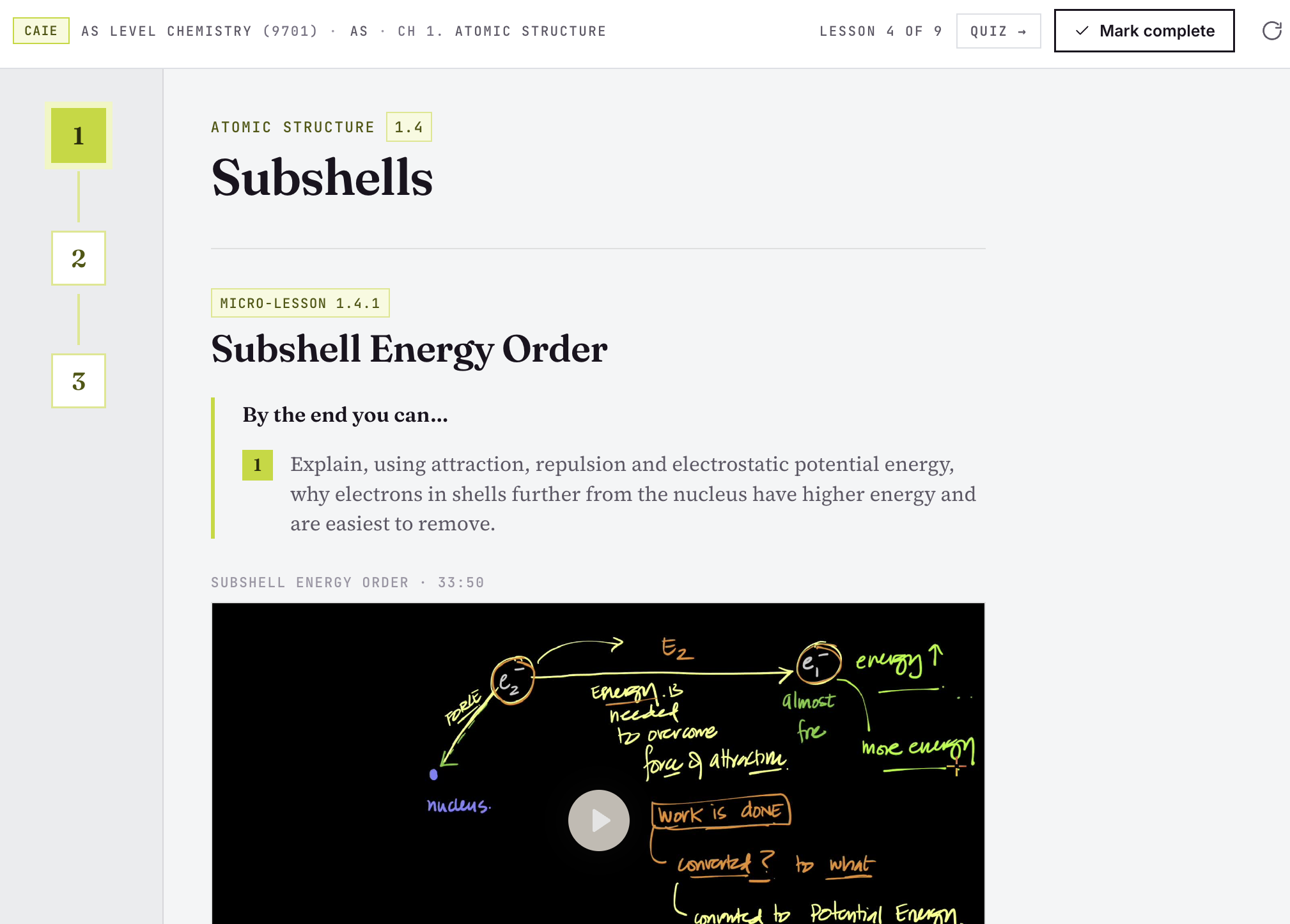
A syllabus tells you what can be examined. The paper decides how ideas are combined, which conditions matter, and what evidence earns the mark.
Describe, explain, calculate, suggest, deduce, and compare demand different performances. Read the command before recalling the chapter.
A question can contain several facts. Some define the context; one or two reveal the Chemistry the student must use.
Temperature, pressure, concentration, state, catalyst, and experimental setup can change which relationship applies.
Stronger is not faster. Concentrated is not strong. A bond inside a molecule is not a force between molecules.
A calculation needs working and units. An explanation needs the steps from cause to result.
Magnesium oxide has a much higher melting point than carbon dioxide. Explain the difference in terms of structure and bonding.
"MgO has strong ionic bonds. CO₂ has weak covalent bonds."
MgO forms a giant ionic lattice, so melting requires substantial energy to overcome strong attractions between its ions. CO₂ is molecular, so melting only overcomes far weaker forces between molecules.
The better answer is not valuable because it is longer. It preserves the distinction the question is testing.
Learn the idea, use it under different conditions, see exactly where the mark was lost, then meet the same misconception again later.
Decide what Chemistry the question is actually testing before you see the worked answer.
Temperature, pressure, concentration or structure changes, so you learn the principle instead of one memorised answer.
Compare your attempt with the correction and see which distinction, step or piece of language was missing.
The same misconception returns in a different question, so fixing it once has to stick.

His course is built around a recurring problem: a student can recognise the chapter, remember the notes, and still lose the mark through selection, application, working, or language.
A lesson is not finished when the video ends. It is finished when you can use the idea in a question you have not seen before.
Know what each quantity means, which relationship applies, and what the result says chemically.
Use forces and patterns to explain trends instead of holding a fragile list in memory.
Follow electrons, conditions, mechanisms, and functional-group relationships as one connected map.
I studied for my A Levels at home due to personal financial reasons and ended up getting an A* in Chemistry.
The video lessons and past paper walkthroughs came in very handy and helped me breeze through Chemistry, especially Organic Chemistry.
In only 1.5 months, I completed Physical Chemistry and am halfway done with Organic Chemistry. Your way of teaching is so sublime and nice.
Full recorded A Level Chemistry, billed one month at a time.
Pay once for A Level Chemistry through your chosen sitting —O/N 2026.
Every included A Level subject — not only Chemistry — on one plan.
Intensive sessions delivered live over video. Bilal covers the hardest chapters, paper technique, and Paper 4 answers directly — with time to ask.
The route is designed for independent study: teaching, chapter notes, Skill Checks, worksheets, revision resources, and past-paper support are connected in sequence. The student still has to attempt the work and return to mistakes.
Yes. The product route connects focused lessons with checks, notes, worksheets, questions, and corrections. Exact resource coverage can vary by chapter, so the course player should remain the source of truth.
Both cover one subject. Monthly is billed one month at a time and does not require a fixed sitting. Exam Pass is one payment for access through one named sitting.
When the student needs two or more of the included A Level subjects. It covers the full included set and can be selected as Monthly or a sitting-specific Exam Pass.
No. Matching recorded Chemistry access is included in the Live plan. The cart deliberately keeps one plan at a time so the student is not charged twice.
No. Online preparation can teach planning, data analysis, evaluation, and uncertainty. It does not replace required hands-on practical experience.

Structured online teaching, practice and exam preparation beyond one classroom or city.